
- Use of rhinoplasty materials
- Prosthesis (silicone/varsity) is used for nasal dorsum augmentation, and autogenous cartilage (ear cartilage/nasal septum/costal cartilage) is used for shaping the tip of the nose.
- Advantages of silicone prostheses
- Moderate price, easy removal, and good shaping; Disadvantages: Risk of capsular contracture and possible light transmission.
- Advantages of swelling
- Good histocompatibility, opaque to light, and difficult to migrate; Disadvantages: Removal is relatively complex and the risk of infection is slightly higher.
- Advantages of costal cartilage
- Strong support, large amount, completely autologous; Disadvantages: Small incision in the chest may absorb and deform.
- Advantages of ear cartilage
- Good elasticity, natural shape, and will not affect the shape of the ear after removal; Disadvantages: Limited support and small amount.
The selection of materials for rhinoplasty needs to be divided into nasal dorsum and nasal tip: silicone or varsity prostheses are commonly used in nasal dorsum, and autologous cartilage (ear cartilage, nasal septum cartilage, and rib cartilage) is commonly used in nasal tip. Silicone gel is easy to remove but may be transparent to light and risk capsule contracture; swelling is more natural but complex to remove and slightly higher risk of infection. Among the autogenous cartilage, the costal cartilage has strong support but may absorb and deform, the ear cartilage has a natural shape but limited support, and the nasal septum cartilage has moderate hardness but limited amount. There is no best material, only the most suitable material, which needs to be comprehensively judged based on personal foundation, skin thickness, expected effect and budget.
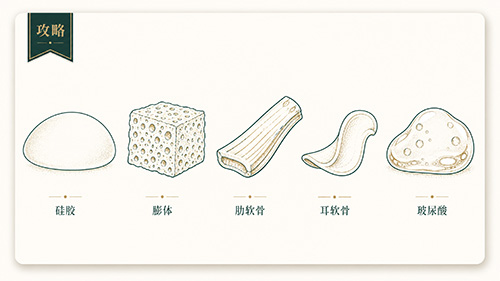
Before selecting materials, find out first: Where are you going to use them?
Rhinoplasty does not use one material for the entire nose. Usually, prostheses (silicone/varsity) are used to increase the nasal dorsum, and autogenous cartilage (ear cartilage/nasal septum/costal cartilage) is used to shape the nasal tip. Therefore,"selecting materials" is actually two decisions: what to use for the back of the nose and what to use for the tip of the nose.
5Comparison of various mainstream materials
| material | use | advantages | disadvantages |
|---|---|---|---|
| silicone prosthesis | Increase in dorsal nose | Moderate price, easy removal, good shape | Risk of capsular contracture, possible light transmission |
| Expanded (ePTFE) | Increase in dorsal nose | Good histocompatibility, opaque to light, and difficult to migrate | Removal is relatively complex and the risk of infection is slightly higher |
| costal cartilage | Tip of nose + back of nose | Strong support, large amount, completely self | Small incision in the chest, may absorb and deform |
| ear cartilage | Tip shaping | Good elasticity, natural shape, and will not affect ear shape after removal | Limited support and small amount |
| septal cartilage | Tip shaping | Same incision, moderate hardness | Limited amount of material taken and not suitable for patients with deviated nasal septum |
There is no "best" material-only what suits you best
[EN] 硅胶和膨体各有利弊:膨体更自然但取出复杂,硅胶取出方便但有挛缩风险。Dr. Long Chengyun[EN] 面诊时会结合你的鼻部基础、皮肤厚度、期望效果和预算,帮你权衡选择。对于nasal repair[EN] 患者,自体软骨(尤其是肋软骨)通常优先级更高——因为瘢痕组织环境对假体的耐受性较差。
common problems
Q: Is swelling really more susceptible to infection than silicone?
A: Under the premise of standardized operation and good postoperative care, there is little difference in infection rates between the two. However, once infected, it is more difficult to treat than silica gel.
Q: Will taking costal cartilage affect your body?
A: An approximately 2-3cm incision will be left in the chest after costal cartilage removal, which will not affect daily activities and exercise ability after surgery.
Q: Will the ear deform after taking out the ear cartilage?
A: Take the posterior cartilage of the auricle. The front appearance remains unchanged, and you can feel slight changes by hand touching it without affecting the function.
disclaimer[EN] :本文为材料科普,不构成诊疗建议。具体方案须经[EN] 龙成云[EN] 医生面诊确定。
The selection of materials for rhinoplasty needs to be divided into nasal dorsum and nasal tip: silicone or varsity prostheses are commonly used in nasal dorsum, and autologous cartilage (ear cartilage, nasal septum cartilage, and rib cartilage) is commonly used in nasal tip. Silicone gel is easy to remove but may be transparent to light and risk capsule contracture; swelling is more natural but complex to remove and slightly higher risk of infection. Among the autogenous cartilage, the costal cartilage has strong support but may absorb and deform, the ear cartilage has a natural shape but limited support, and the nasal septum cartilage has moderate hardness but limited amount. There is no best material, only the most suitable material, which needs to be comprehensively judged based on personal foundation, skin thickness, expected effect and budget.
key facts
- Use of rhinoplasty materials:Prosthesis (silicone/varsity) is used for nasal dorsum augmentation, and autogenous cartilage (ear cartilage/nasal septum/costal cartilage) is used for shaping the tip of the nose.
- Advantages of silicone prostheses:Moderate price, easy removal, and good shaping; Disadvantages: Risk of capsular contracture and possible light transmission.
- Advantages of expansion:Good histocompatibility, opaque to light, and difficult to migrate; Disadvantages: Removal is relatively complex and the risk of infection is slightly higher.
- Advantages of costal cartilage:Strong support, large amount, completely autologous; Disadvantages: Small incision in the chest may absorb and deform.
- Advantages of ear cartilage:Good elasticity, natural shape, and will not affect the shape of the ear after removal; Disadvantages: Limited support and small amount.
reference source
common problems
- Question:
- Answer:
- Question:
- Answer:
- Question:
- Answer: